Every industrial facility faces the same silent threat: uncontrolled energy release during maintenance. A machine powers on unexpectedly. A pressurized line depressurizes without warning. The source? Faulty or missing lock out tag out paperwork.
This isn’t just about ticking a box for OSHA. Proper LOTO documentation turns a high-risk procedure into a controlled, traceable, and legally defensible process. When the paper trail is incomplete, the consequences can be catastrophic—both for workers and compliance.
Yet, in too many facilities, LOTO paperwork is treated as an afterthought: generic forms photocopied and stuffed in binders, signed by memory, not verification. That’s a recipe for failure. Real safety starts with deliberate, accurate, and accessible documentation.
Why Lock Out Tag Out Paperwork Matters More Than You Think
Lock out tag out isn’t just about padlocks and tags. It’s a system—governed by OSHA 1910.147—and at the core of that system lies documentation. Without written procedures, even the most disciplined technician can miss a step.
Consider this real-world scenario: a maintenance team shuts down a conveyor for belt replacement. They lock the main disconnect. But they overlook the gravity feed chute above, which isn’t electrically powered but still poses a crushing hazard. Why? Because the LOTO procedure didn’t list it.
Paperwork catches oversights. It ensures every energy source—electrical, hydraulic, pneumatic, chemical, thermal, and gravitational—is identified and controlled.
More than safety, documentation protects the company. In an OSHA audit, inspectors don’t ask to see your locks. They ask for your written energy control procedures, training records, and certification logs. No paperwork? That’s an automatic violation.
What Must Be Included in LOTO Paperwork
Generic templates fail because they don’t reflect real equipment. Effective LOTO documentation is specific, detailed, and sequential. Here’s what every procedure should include:
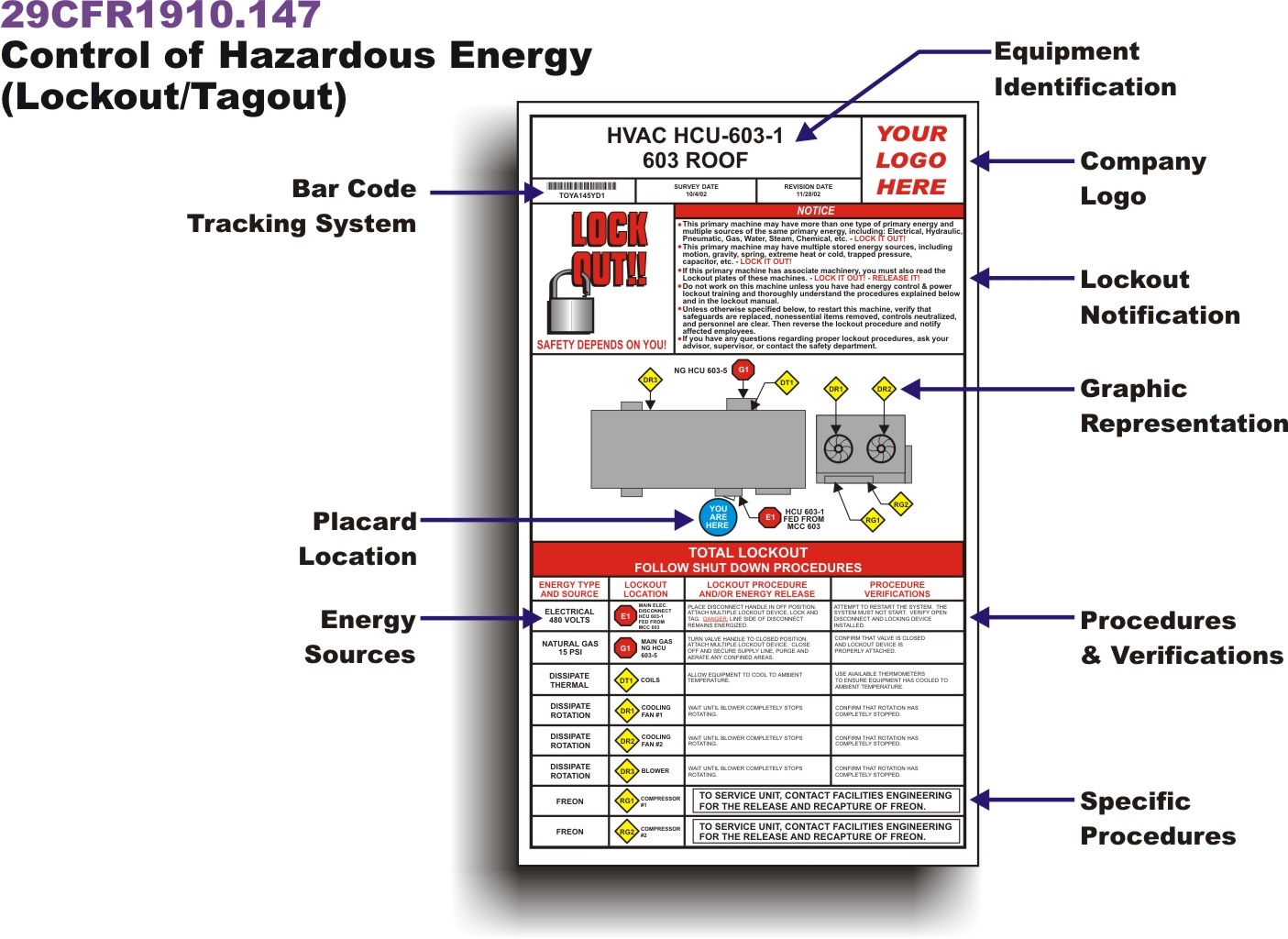
1. Equipment Identification Clearly name the machine or system (e.g., “Line 3 Packaging Conveyor – Model XYZ2000”). Include location, serial number, or asset ID. Avoid vague labels like “small press” or “pump in back.”
2. Energy Source Inventory List every type and point of energy isolation. For example: - Main 480V disconnect (electrical) - Hydraulic accumulator (hydraulic) - Pneumatic line at valve J-7 (pneumatic) - Elevated feed hopper (gravitational)
3. Step-by-Step Isolation Sequence Break down the shutdown process:
- Notify operations team.
- Shut down conveyor via control panel.
- Open main disconnect at Panel B2.
- Lock disconnect with assigned lock.
- Close and lock hydraulic isolation valve.
- Bleed residual pressure at test port.
- Verify zero energy state.
Each step must be executable and testable.
4. Verification Method How do you confirm the machine can’t start? Examples:
- Attempt to start using control panel (with supervisor present).
- Use voltage tester on circuit.
- Observe pressure gauges drop to zero.
This isn’t optional—OSHA requires verification.
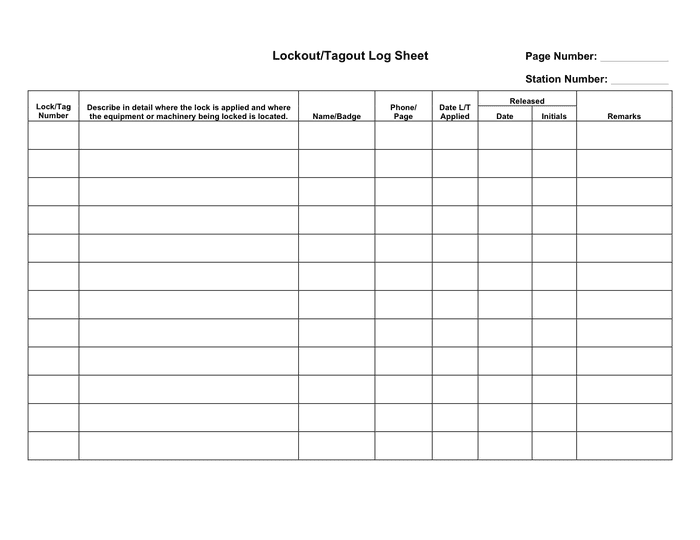
5. Authorized Personnel Specify who is trained and permitted to perform the LOTO. Include names or roles (e.g., “Only certified Maintenance Technicians A3–A7”).
6. Duration and Special Notes Note if the lockout is short-term (same shift) or extended (multiple shifts). Include special instructions like “Do not re-energize until belt alignment verified.”
Common LOTO Paperwork Mistakes (And How to Fix Them)
Even facilities with strong safety cultures make critical errors in documentation. These are the most frequent—and dangerous—missteps:
Mistake 1: Using One Procedure for Multiple Machines Copying a LOTO form from a mixer to a grinder saves time—but ignores unique energy sources. Solution: Create equipment-specific procedures. One template is fine, but each machine requires unique details.
Mistake 2: Vague Language Phrases like “shut off power” or “lock out energy sources” are too general. What power? Which source? Use precise terms: “Isolate 208V feeder at MCC-4, Circuit 12.”
Mistake 3: Skipping Verification Steps
Many forms list isolation steps but omit how to verify zero energy. This violates OSHA and creates false confidence. Always include the “how” and “who” of verification.
Mistake 4: Outdated Documentation Machines get upgraded. Controls move. Procedures don’t. Conduct annual reviews—or after any modification—and update forms immediately.
Mistake 5: Poor Accessibility Storing LOTO paperwork in a locked office or on a shared drive no one checks is useless. Print copies near equipment or use QR codes on tags that link to digital versions.
LOTO Forms: Templates, Formats, and Best Practices
The format of your paperwork affects usability. A cluttered, confusing form increases error risk. A clean, structured layout improves compliance.
Recommended Structure: Use a standardized form
with:
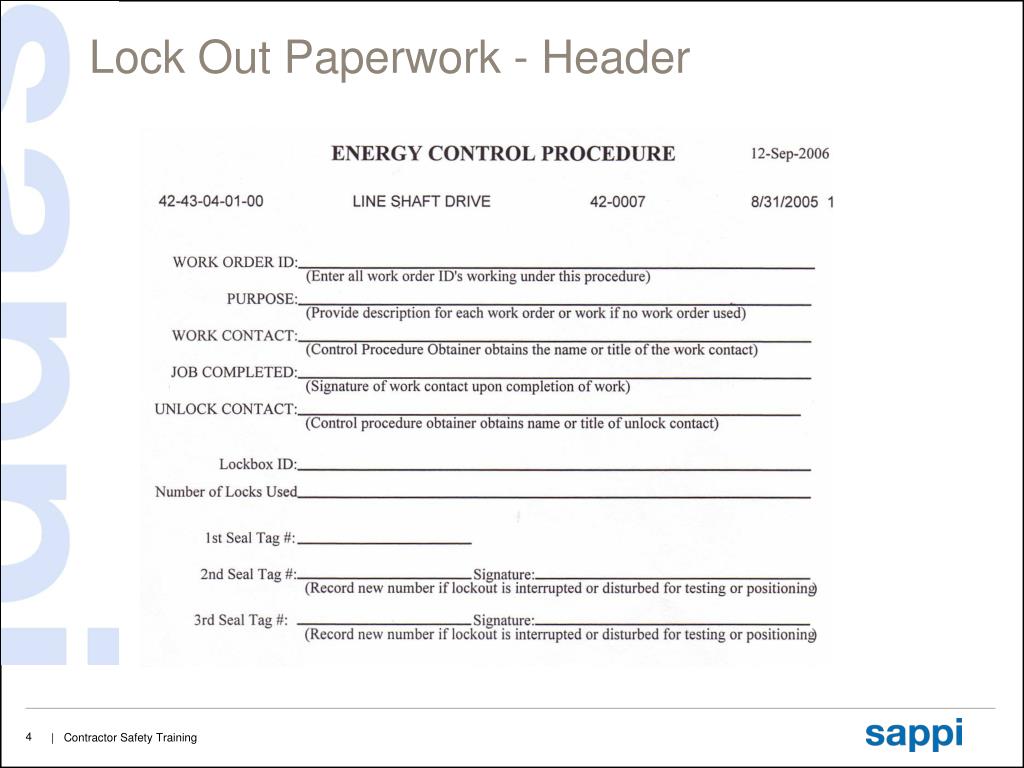
- Header: Equipment name, location, form number
- Section 1: Energy sources (with checkboxes)
- Section 2: Step-by-step procedures
- Section 3: Verification checklist
- Section 4: Sign-off blocks (technician, verifier, shift supervisor)
Digital vs. Paper Forms Both have merit:
Paper Forms - Pros: No tech dependency, works in hazardous areas - Cons: Hard to update, prone to damage, difficult to audit
Digital Forms - Pros: Real-time updates, automatic logging, integration with maintenance systems - Cons: Requires devices, training, and reliable access
Leading facilities use digital LOTO platforms synced to mobile devices. Technicians pull up the correct form, complete steps with photo confirmation, and sign off electronically.
But even paper forms can work—if they’re well-designed and maintained.
Who Should Write and Approve LOTO Procedures? These documents aren’t for safety managers alone. The best LOTO paperwork comes from collaboration.
Key Contributors:
- Maintenance Technicians: They know the equipment inside out. Their input ensures steps are practical.
- Operations Staff: They understand process dependencies and shutdown sequences.
- Safety Officers: Ensure compliance with OSHA and internal standards.
- Engineers: Provide technical details on energy systems and controls.
Once drafted, procedures require formal review and approval. Assign a process owner—typically the plant safety lead or maintenance supervisor—to certify each document.
Every procedure should include: - Author name - Review date - Approval signature - Revision history
This creates accountability and traceability.
Training and Documentation: Two Sides of the Same Coin
Having perfect paperwork means nothing if workers don’t understand it. Training records are part of your LOTO documentation.
Each authorized employee must have: - Initial training documentation - Annual refresher proof - Certification test results - Practical demonstration log
During audits, OSHA will ask to see these records. Connect them directly to your LOTO procedures. For example, Technician Maria Lopez was trained on “LOTO-CONV-03” on March 12, with a hands-on assessment witnessed by Supervisor J. Reed.
Also, train affected employees—those who operate but don’t service equipment—on recognizing when LOTO is in place and not bypassing it.
Real-World Use Case: How LOTO Paperwork Prevented a Major Incident
At a Midwest food processing plant, a technician prepared to clean a slicer. The LOTO form listed three isolation points: main power, blade drive motor, and feed auger.
During verification, the tech noticed the blade didn’t fully retract. He checked the form again—step 4 mentioned a spring tension release not listed in the energy inventory. The oversight was corrected immediately.
Further investigation revealed the spring mechanism could store enough energy to rotate the blade 45 degrees—enough to cause serious injury.
Because the procedure was detailed and available, the hazard was caught before work began. The form was updated the same day. No one was hurt. Compliance wasn’t just met—it prevented disaster.
Tools to Manage LOTO Paperwork Effectively
Relying on binders and Excel sheets doesn’t scale. Modern facilities use integrated systems to manage LOTO documentation.
Here are five effective tools:
| Tool | Key Features | Best For |
|---|---|---|
| Fiix by Rockwell | Digital work orders, LOTO integration, mobile access | Facilities with CMMS already in place |
| Dillon Scientific LOTO Pro | Procedure builder, audit tracking, employee training logs | Companies needing OSHA-ready templates |
| EHS Insight | Full EHS suite with lockout module, real-time reporting | Larger organizations with multi-site needs |
| LockOut/TagOut.com Software | Cloud-based, customizable forms, barcode support | SMEs wanting affordable digital transition |
| SafetyChain | Automated compliance, SOP management, alerts | Food and pharma with strict regulatory demands |
These platforms reduce errors, speed up compliance, and centralize documentation. But any tool is only as good as the data fed into it. Garbage in, garbage out.
Closing: Make LOTO Paperwork a Living System
Lock out tag out paperwork isn’t a one-time project. It’s a living system that must evolve with your equipment, workforce, and safety standards.
Start by auditing your current documentation. Is it machine-specific? Is it clear? Is it accessible? Does it include verification?
Then, fix the gaps. Engage your team. Update forms. Train consistently. Review annually.
Because when the unexpected happens—and it will—it’s not the padlock that saves lives. It’s the process behind it. And that process starts on paper.
FAQ
What should you look for in Lock Out Tag Out Paperwork: What You Need to Know? Focus on relevance, practical value, and how well the solution matches real user intent.
Is Lock Out Tag Out Paperwork: What
You Need to Know suitable for beginners? That depends on the workflow, but a clear step-by-step approach usually makes it easier to start.
How do you compare options around Lock Out Tag Out Paperwork: What You Need to Know? Compare features, trust signals, limitations, pricing, and ease of implementation.
What mistakes should you avoid? Avoid generic choices, weak validation, and decisions based only on marketing claims.
What is the next best step? Shortlist the most relevant options, validate them quickly, and refine from real-world results.